
Tulane law students take lead roles in high-stakes environmental and civil rights cases
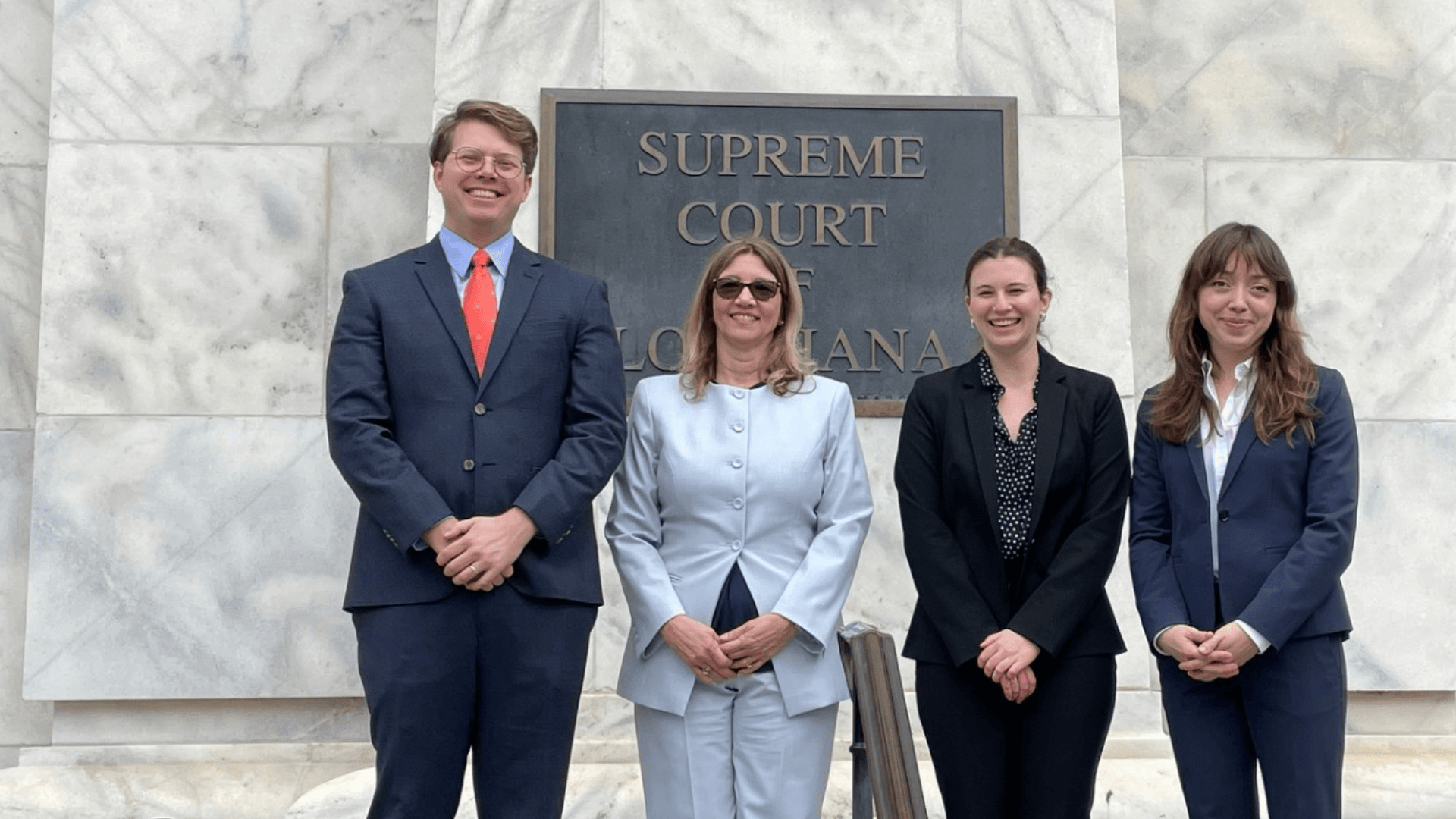
Tulane Law students in the Environmental Law Clinic are arguing complex environmental and civil rights cases in courts across Louisiana, challenging industrial permits, land-use decisions and alleged discriminatory practices.
In recent months, students have appeared in state and federal district courts, before the Louisiana Supreme Court, and in a state appellate court. Three students successfully argued cases that resulted in rulings in the clinic’s favor.
“This is exactly the kind of work that defines Tulane Law,” Dean Marcilynn Burke said. “Our students are not just learning the law, they are applying it in complex, high-stakes cases with real-world consequences. That level of responsibility and impact is extraordinary, and it speaks to both the strength of our clinical programs and the talent and commitment of our students, faculty, and staff.”

In December, third-year law students Peter DiPaola and Varun Hukeri argued procedural motions in Carolyn Peters v. Louisiana Department of Environmental Quality in the 19th Judicial District Court. The case challenges the renewal of an air permit for Indorama Ventures Olefins, a petrochemical facility in Westlake.
The lawsuit, brought on behalf of nine community members of Mossville, alleges the agency improperly approved increased emissions of pollutants including 1,3-butadiene, a known carcinogen. Students argued that the administrative record was legally insufficient and that regulators failed to adequately consider existing air quality conditions.

Weeks later, third-year law student Kiley Maher argued before the Louisiana Supreme Court in Alexander v. St. James Parish, a closely watched land-use dispute. The case challenged parish approval of a pipeline and facility expansion for Koch Methanol.
In January, Isabelle Adoue, a third-year student, successfully argued in federal court on behalf of Rise St. James against a motion to dismiss in Inclusive Louisiana v. St. James Parish, a civil rights case alleging the parish has concentrated heavy industrial development in its majority-Black Fourth and Fifth Districts while shielding majority-white areas.

Adoue defended the client’s substantive due process claims, arguing the complaint plausibly alleges violations of residents’ constitutional rights to bodily integrity and to be free from state-created danger under the 14th Amendment. The judge denied the motion to dismiss, allowing the case to proceed.
"This is exactly the kind of experience I hoped for when I came to law school,” Adoue said. “Arguing this case through the clinic brought together everything I’ve learned in the classroom and pushed me to apply it in a real, practical setting. It felt like a true culmination of my legal education so far."
In February, Matthew Turner argued before the Louisiana Fifth Circuit Court of Appeal in Genevieve Butler, et al. v. St. James Parish, et al., an Open Meetings Law case challenging what plaintiffs describe as an illegal “walking quorum” related to approval of a chemical manufacturing facility.

The clinic prevailed at trial in 2024, with a judge ruling the sessions were an unlawful “means to circumvent the intent” of the state's Open Meetings Law. Turner’s appellate argument sought to preserve that ruling, emphasizing the public’s right to transparency in decisions involving potential health and safety risks. At the end of February, the Fifth Circuit issued its ruling that affirmed the trial court’s verdict.
“The clinic has been the most invaluable experience I have had in law school,” Turner said. “Being able to argue a real case, in front of real judges, for real clients that appreciate your help in fighting for them is an opportunity that has changed my outlook on being a lawyer for the better. The education learned at Tulane and the type of work the clinic takes on matters—and nothing has shown that to me quite like my current case.”
Faculty supervisors say the students’ courtroom work reflects the clinic’s mission to combine rigorous legal training with community advocacy while giving students rare opportunities to litigate cases with lasting consequences.
