
Tulane Professors Examine “Seismic Shift” in College Sports in Harvard Journal
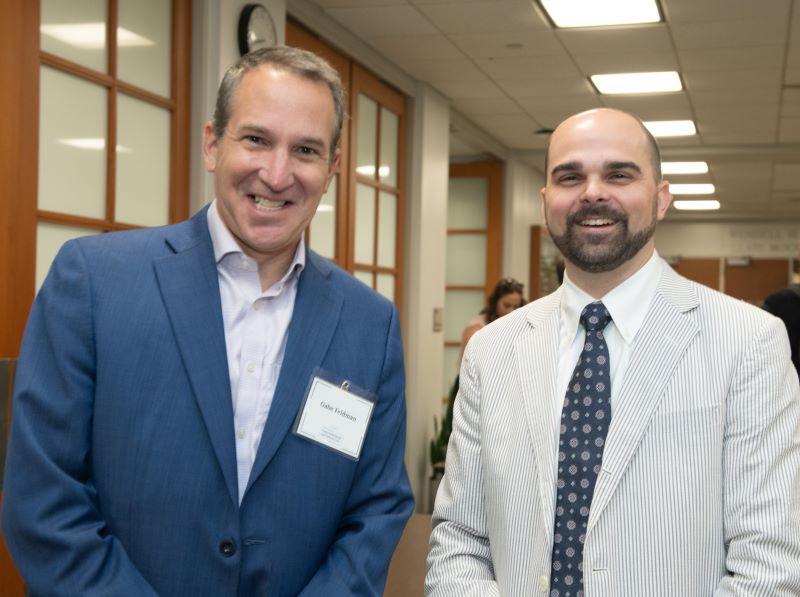
Tulane Law School’s Professor Gabe Feldman and Sports Law Program Manager Eric Blevins are drawing national attention to the rapidly evolving landscape of college athletics with a new scholarly article published in the Harvard Journal of Sports and Entertainment Law.
In their article, “Preserving a Tradition or Creating a New One? The Legal Benefits of an Enhanced Educational Model for College Sports,” Feldman and Blevins explore what they describe as a “seismic shift” in intercollegiate athletics, one that is fundamentally reshaping the relationship between college sports and higher education.
The authors argue that the historic model of college athletics, long grounded in amateurism and educational values, is increasingly under strain. A growing influx of commercial interests and revenue has widened the gap between athletics and academics, raising critical legal and institutional questions about the future of the NCAA and its member institutions.
The authors argue that the historic model of college athletics, long grounded in amateurism and educational values, is increasingly under strain.
“This is a moment of profound transformation,” the authors suggest, noting that the structure of college sports may change more in the current decade than at any other time in NCAA history.
Feldman, the Sher Garner Professor of Sports Law, Director of Tulane’s nationally-recognized Sports Law Program, and co-Director of the Tulane Center for Sport; and Blevins, Sports Law Program Manager with the Center for Sport and Adjunct Lecturer with Tulane’s A.B. Freeman School of Business, are leading voices in sports law and policy. Their latest work builds on years of scholarship and engagement with the legal challenges facing collegiate athletics.
Central to their argument is that the growing disconnect between athletics and education has eroded the legal protections historically afforded to college sports. Courts, they note, have become increasingly skeptical of the NCAA’s claims to amateurism, exposing the system to heightened scrutiny under antitrust and labor laws.
To address these challenges, Feldman and Blevins propose an “Enhanced Educational Model” that would more fully integrate athletics into the academic mission of universities by providing academic credit for athletic participation alongside rigorous classroom instruction applying traditional subject matters, like math, sciences, and psychology, to sports.
The model seeks to recognize the educational value of athletic participation and reposition some college sports as a legitimate component of higher education, rather than a commercial enterprise operating alongside it. Additionally, this new model offers improved legal protection because the turn towards education addresses today’s strongest legal criticisms of college sports. Notably, the proposal does not necessarily require that schools abandon “major” revenue-producing sports, but that the new educational model could operate in parallel to them and encompass Olympic and other non-revenue sports."
The authors further explore these ideas in a recent podcast conversation, where they describe college athletics as “at a crossroads” and outline how reimagining sports as a form of experiential learning could help institutions navigate mounting legal and financial pressures.
Their proposal arrives at a pivotal time for college athletics, as universities, policymakers, and courts grapple with issues ranging from athlete compensation to governance reforms. Across the country, observers have noted that the traditional focus on education and amateur competition is increasingly giving way to financial incentives and commercialization, further blurring the line between college and professional sports.
By offering a framework that merges athletics and education, Feldman and Blevins aim to provide both a legal and philosophical path forward—one that preserves the core values of higher education while adapting to the realities of a changing sports landscape.
The full article is available through the Harvard Journal of Sports and Entertainment Law, and the accompanying podcast provides additional insight into the authors’ vision for the future of college athletics.
